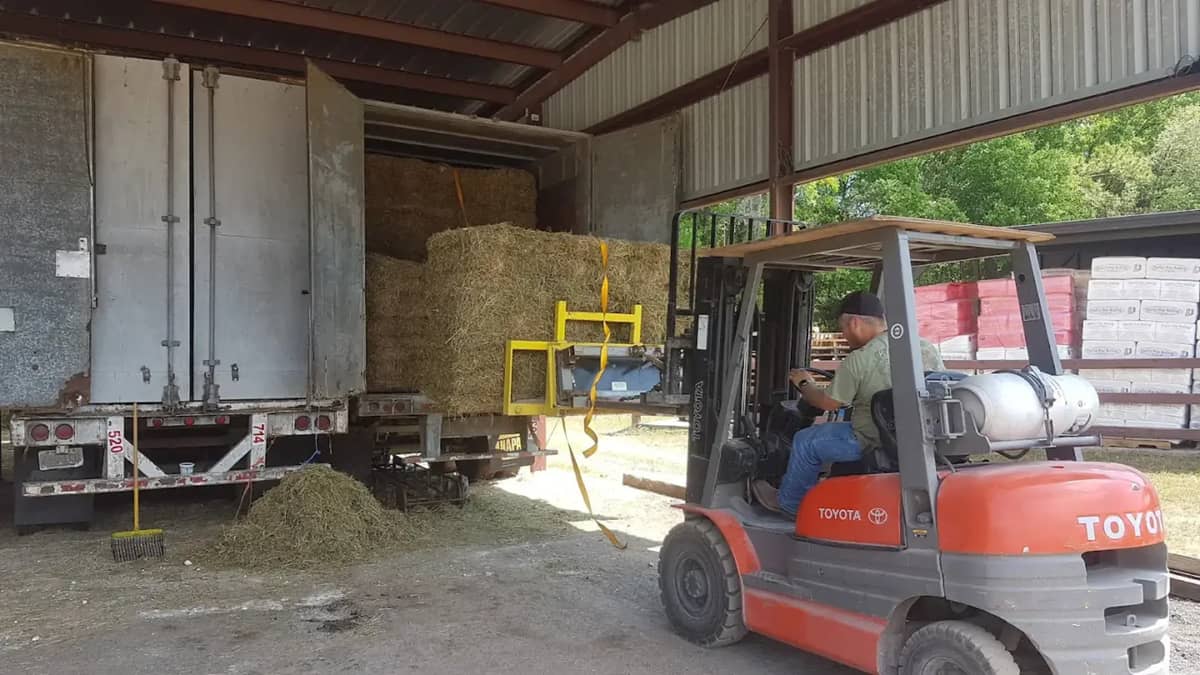
Western Horse Hay in Florida
On this page
Trennis Ropp is a co-owner of Farmers Direct Hay and Feed in Williston, Florida, and a fifth-generation farmer.
Western hay is grass and legume hay grown under irrigation in the dry western states and shipped east. Most of ours is grown on the family's own Nevada farm, the rest comes from Nevada and the surrounding western states, and a set number of contracted loads a year come from Alberta for our Canadian hay. Nine of our products publish an Equi-Analytical panel you can download before you buy. We are in Williston, FL, roughly 23 miles from Ocala. Buy by the bale at the counter, by the pallet, or by the container of roughly 130 bales with free delivery inside 40 miles. Call (352) 528-1255.
Search horse hay in Florida and you get two very different products under one word. There is hay cut here in the Southeast, and there is hay grown out west under irrigation and trucked in. Both feed horses. They are not the same buying decision, and if you board, show, or manage a barn where the ration has to stay put from month to month, the difference is the whole point. This is a guide to buying the western side of that: what it is, what ours tests at, and how to get it delivered in North Central Florida.
What "western hay" actually means
Western hay is grass or legume hay grown in the dry, irrigated west, cured in low humidity, and hauled east. The reason it exists as a category is weather. A grower out west controls water with irrigation instead of hoping for it, and cures a windrow in dry air instead of racing a thunderstorm. That is a growing-condition difference, not a marketing one.
Here is our sourcing, stated plainly, because it is the question we get asked most:
- Most of our hay is grown on the family's own farm in Nevada.
- What we cannot grow ourselves we buy from Nevada and the surrounding western states: a fair amount of Idaho, some Utah, a little California, a little Arizona. Those states get picked for irrigation and a dry climate.
- We contract a set number of loads each year out of Alberta, Canada for our Canadian-grown hay.
- Our peanut hay is the exception to all of the above. It is locally grown in the Southeast, not trucked in from out west.
We do not say every bale comes off our own farm, because it does not.
The western hay we stock, and what it tested at
We send samples to Equi-Analytical Laboratories on the Fast Track 600 package. We test the field, not every bale, so read a panel as a description of the lot, not as a promise about one bale in your trailer. Nine of our products publish a downloadable panel. Crude protein below is as fed, and the NSC figure is water soluble carbohydrates plus starch added together, since Equi-Analytical does not print an NSC line.
- Ultra Premium Alfalfa, 3-string, $38.50. Crude protein 25.1 percent, NSC 10.9 percent, RFV 249. Sampled June 30, 2026, report 31499490.
- Premium Alfalfa, 3-string, $36.00. Crude protein 24.8 percent, NSC 10.8 percent, RFV 223. Sampled June 30, 2026, report 31499510. Grown in Nevada.
- Orchard Alfalfa Mix, 3-string, $39.50. Crude protein 21.5 percent, NSC 9.1 percent, RFV 176. Sampled June 30, 2026, report 31499500. Grown in Nevada.
- Timothy Alfalfa Mix, 3-string, $42.00. Crude protein 19.9 percent, NSC 11.6 percent, RFV 177. Sampled June 30, 2026, report 31499480. Western US.
- Timothy 2nd Cut, 3-string, $40.50. Crude protein 14.8 percent, NSC 7.5 percent, RFV 107. Sampled August 4, 2025, report 30889240. Grown in Nevada.
- Ultra Premium 2nd Cut Timothy, 3-string, $44.50. Crude protein 13.8 percent, NSC 11.3 percent, RFV 108. Sampled June 30, 2026, report 31499460. Western US.
- Orchard Grass, 3-string, $39.75. Crude protein 10.3 percent, NSC 11.7 percent, RFV 104. Sampled August 4, 2025, report 30889210. Grown in Nevada.
- Teff Grass, 3-string, $39.00. Crude protein 7.1 percent, NSC 8.6 percent, RFV 86. Sampled August 4, 2025, report 30889200. A warm season grass, and its own category rather than a timothy or an orchard.
- Timothy 1st Cut, 3-string, $39.50. Panel published on the product page with a downloadable PDF. Ask us for the current lot figures on the phone before you order.
Two things a buyer should take from that list. First, sample dates differ, so compare two products by their panels rather than assuming a category ranking holds across every lot. Second, the ESC plus starch line on the PDF is what your vet wants if a horse is being managed for sugar. A hay name is a filter. The lab sheet is the answer.
Matching the hay to the horse
We are not going to tell you what to feed your horse, and any real change should go past your vet. What we can do is tell you which shelf people usually end up on:
- Maintenance and easy keepers: a grass hay. Orchard or timothy, and teff when sugar is the constraint.
- Hard keepers, growing horses, broodmares, horses in work: more protein in the ration, which is where alfalfa or a timothy alfalfa mix comes in. Our alfalfa feeding guide covers how owners usually work it in.
- Metabolic horses, insulin resistance, laminitis history: your vet gives you an NSC ceiling and you buy against the panel, not the label. Start at our metabolic horse feeding guide.
- Not sure: the hay finder walks the questions, or call and describe the horse.
Whatever you land on, change forage gradually rather than all at once.
By the bale, the pallet or the container
How much you buy at a time changes the economics more than which variety you pick.
- By the bale. Pull up to the store and we will load you. Good if you have a couple of horses and a pickup.
- Barn quantity and repeat orders. If you are running a boarding, training or lesson barn and want the same hay load after load, that is a phone conversation about what we are cutting and when the next one lands. Start on our wholesale page.
- By the container. Roughly 130 bales in a shipping container, delivered free inside 40 miles, sitting on your property with the first 30 days of storage free and $25 a week after that. When it is empty we bring a full one and take the empty back. This is the answer for a barn tired of a weekly hay run, and it keeps the hay off the ground and under a roof.
Florida humidity is the enemy of hay you paid good money for. Whatever quantity you take, get it off the concrete and out of the weather. We wrote up the storage side in hay storage in Florida heat and humidity.
How to order and what delivery costs
There is no cart on our site. Every product page says "Call to order", because the count, the variety, the pickup or delivery, and the day all get settled on one call. That is (352) 528-1255.
Store. 21091 NE US Hwy 27, Williston, FL 32696. Monday through Friday 9am to 5:30pm, Saturday 9am to 2:30pm, closed Sunday.
Delivery, flat rate on driving distance from Williston:
- Inside 25 miles: $35 flat. Ocala is in this band, roughly 23 miles out.
- 25 to 40 miles: $40 flat, which covers Belleview and Summerfield.
- Past 40 miles: custom quote, call us.
- Container of roughly 130 bales, up to 40 miles: free.
Deliveries run Monday through Saturday during business hours across Marion, Alachua, Levy, Citrus, Sumter and Putnam counties, including Gainesville, Newberry, Archer, Bronson, Chiefland, Dunnellon, Reddick, Micanopy, Keystone Heights and The Villages. Give us 2 to 3 business days of notice, and an order in before 3:00 PM Eastern can be scheduled for the next business day. Rate card and full city list: the delivery page.
Questions we get from barn managers
Can I keep getting the same hay every month? That is the reason to call rather than shop around each time. Tell us what you are feeding and how fast you go through it, and we will tell you what is on the current cut and when the next one lands.
Can I see the lab report before I buy? Yes. Nine product pages carry a downloadable PDF panel with the report ID on it. For a product not on that list, ask us on the phone.
Do you sell by the ton or the truckload? Call and describe the volume. Larger orders start at our wholesale page and get quoted on the phone.
Do you deliver to Ocala? Yes, $35 flat, and Ocala has its own page with the local detail: hay delivery to Ocala.
What if a bale is bad? Bring it back and we will exchange it. Full unused bales can come back for a refund or exchange. Opened or partly used bales we cannot take.
The short version
Western hay is grown under irrigation and cured in dry air, then hauled to Florida. Most of ours comes off the family's Nevada farm, the rest from Nevada and neighboring western states, plus contracted Alberta loads for the Canadian hay. Nine varieties publish a lab panel you can read before you buy. Come to the counter in Williston, or take it by the container and stop making the weekly run. Call (352) 528-1255.
From the Williston yard
Questions about the right hay for your horse?
Call Hailey at the Williston store, or browse the catalog and we will get a load on the truck. Hay delivery runs across North Central Florida.