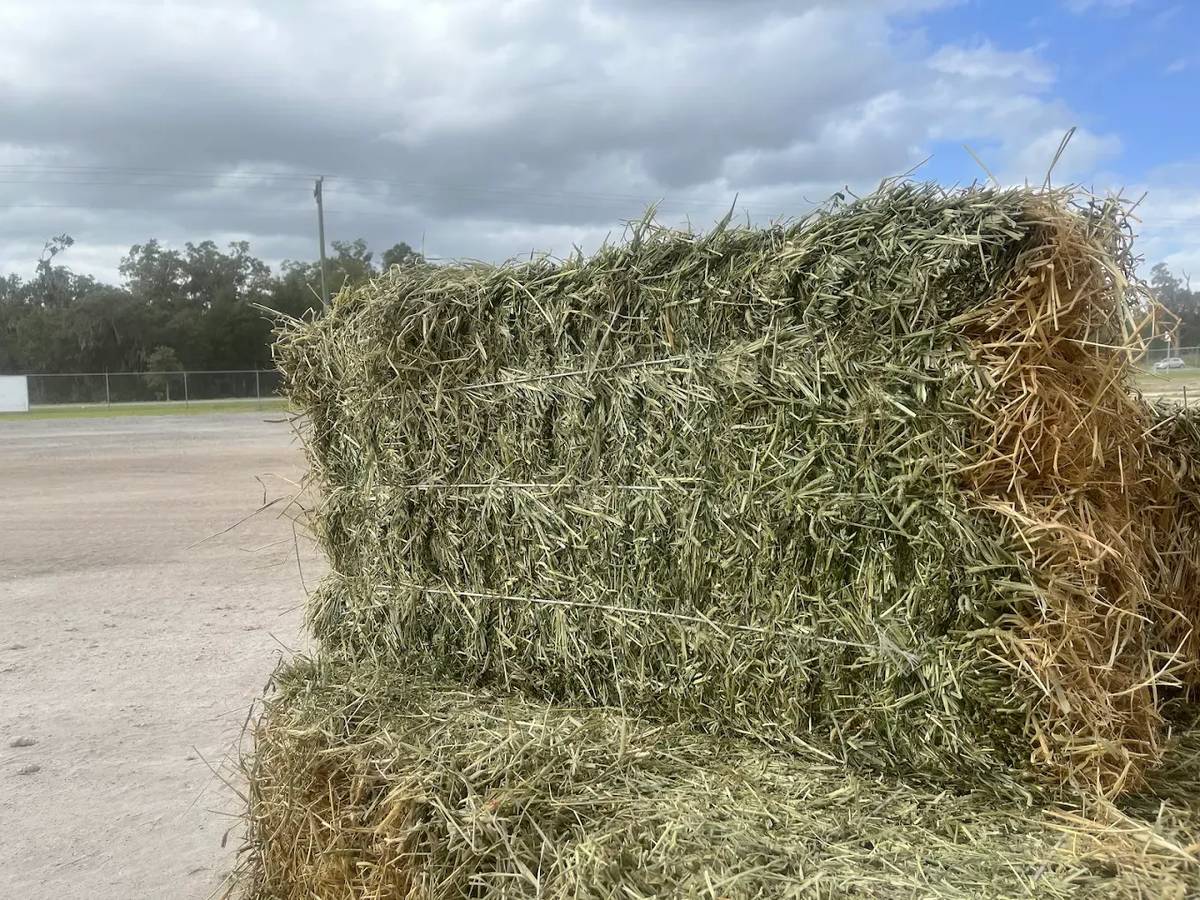
How Much Does a Bale of Hay Cost in Florida?
On this page
- The Quick Answer: What Hay Bales Cost
- What does a bale of hay actually cost?
- Why hay costs more in Florida than it does out West
- Bale size changes the price more than you think
- Why the cheapest bale usually costs you more
- How to figure your real cost per feeding
- What you are actually paying for in a good bale
- Cheap bale vs quality bale: what you actually pay
- How to buy hay that is worth the money
- Frequently Asked Questions
Trennis Ropp is a co-owner of Farmers Direct Hay and Feed in Williston, Florida, and a fifth-generation farmer. He ran the shipping and logistics side of the family hay business for years before he and Delmar took over the Williston store in September 2024.
The price on the tag is only part of what a bale of hay costs you. Freight is what makes good Western hay expensive on the East Coast, and the cheapest bale on the lot is usually cheap because it was grown for tonnage, not for what a horse will actually eat. When a horse sorts a low quality bale and leaves the stems on the floor, you paid for hay that went out with the bedding. The number that matters is what you pay per pound your horse actually eats, not the sticker on the bale.
The price of hay bales for horses moves around a lot, and the cheapest bale on the lot is rarely the deal it looks like. We field the price question every week at the counter in Williston, so here is a straight answer: what a bale of hay actually costs, what drives the price, and why buying on sticker price alone usually costs you more in the end.
The Quick Answer: What Hay Bales Cost
A bale of horse hay in Central Florida generally costs between the high teens and the mid forties, depending on the hay type and the cutting. From our own price board in Williston:
- Peanut hay: $18 a bale, the most affordable legume we carry
- Blended grass and alfalfa bales: $39.50 to $42 a bale
- Premium timothy: $39.50 to $44.50 a bale depending on the cutting
- Alfalfa big bales for volume buyers: $520 per ton
Prices move with the season and the source, so treat these as a snapshot and call (352) 528-1255 for a current quote. The rest of this guide covers why the numbers land where they do.
What does a bale of hay actually cost?
A bale of horse hay in Central Florida generally runs somewhere from the high teens to the mid forties, depending on the type and the cutting. For reference, here is where our own bales sit at the Williston yard as of mid-2026:
- Peanut hay: $18 a bale
- Our grass and alfalfa blends: $39.50 to $42 a bale
- Premium alfalfa (three string): $36.00 a bale
- Orchard grass, teff, and the orchard alfalfa mix: $39.00 to $39.75 a bale
- Timothy, first and second cutting: $39.50 to $40.50 a bale
- Ultra premium second cut timothy: $44.50 a bale
Prices change with the season and the source, so treat those as a snapshot, not a permanent quote. The point is the spread. A peanut hay bale and a premium timothy bale are not the same product, and the price gap between them is mostly a story about freight and quality, not markup.
Why hay costs more in Florida than it does out West
Freight is the single biggest reason good hay is expensive on the East Coast. Most of the premium grass hay and alfalfa fed to horses in Florida is grown in the Western states and Canada, because timothy, orchard grass, and alfalfa are cool season crops that do not grow well in our heat and humidity. Getting that hay here means trucking it across the country.
People remember hay being four dollars a bale out West, and out there it may well be. I spent years on the shipping side of this business, and by the time that same bale rides a truck to Florida, the freight has nearly doubled the cost before anyone adds a dime of margin. That is most of the difference between a Western price and a Florida price. It is not the farmer getting rich. It is diesel and miles.
The other thing that moves hay prices is plain supply and demand. A drought or a panic gets people overbuying, the next year comes in with too much hay, and the price tanks. Those swings can take three or four years to work out. We would rather price even and steady than chase the spikes, but the national market is the national market, and it sets the floor under everyone.
Bale size changes the price more than you think
Two hay prices are not comparable until you know what each bale weighs. A three-string bale weighs close to double a two-string bale, so two bales with similar stickers can be very different deals once you weigh them. Always ask what a bale weighs, then divide the price by the weight to compare honestly. For barns that move real volume, we also sell alfalfa in big bales at $520 per ton, which only pencils out if you can store it and use it before it loses quality.
Why the cheapest bale usually costs you more
The cheapest bale usually costs you more because it was grown for maximum tonnage instead of for what a horse will actually eat. Hay grown that way comes in heavier and coarser, with big stems and not much leaf, so your horse sorts it and leaves a chunk of it behind. You paid for weight your horse never ate.
Your horse can tell the difference. Horses use smell and texture to decide what to eat, and a coarse, stemmy bale gets picked through. Your horse pulls the leaf it wants, pushes the stems to the edge, and walks away. A good part of a poor bale ends up on the stall floor.
That left behind hay does not go back in the feeder. It mixes into the shavings, goes in the wheelbarrow, and ends up in the dumpster. Some owners get worn down enough by the waste that they give up on loose hay and switch to processed feed just to stop the mess, when the real problem was a bale the horse would not clean up in the first place.
What waste looks like from the barn aisle:
- A ring of rejected stems pushed to the edge of the feeder
- Hay scattered into the bedding where you cannot reclaim it
- A horse that eats for a few minutes, loses interest, and walks off
- Hay a horse has urinated on, which is gone no matter how much is left
How to figure your real cost per feeding
The fix is to stop pricing hay by the bale and start pricing it by the pound your horse actually eats. The math is simple. If your horse wastes a quarter of a low quality bale, you bought the whole bale but your horse ate three quarters of it, so your real cost per pound eaten is about a third higher than the sticker.
That does not always make a cheap bale more expensive than a premium one in raw dollars. What it does is shrink the gap you thought you were saving, and it does that before you count the nutrition your horse missed and the bedding you threw away with the stems. A bale your horse will not clean up is a bale you partly paid for and never used, whatever the tag said.
A tip from the yard: Watch one full feeding cycle and check the stall two hours later. Whatever is on the floor is the part of that bale you paid for and your horse did not eat. Do it across a week and you will have a better read on your true forage cost than any price tag can give you. If you want help running those numbers for your barn, our hay feeding calculator is a good starting point.
What you are actually paying for in a good bale
A higher priced bale is buying you two things: forage your horse will eat completely, and a known quantity. We test the field, not each bale, through Equi-Analytical on their Fast Track 600 panel, and that analysis lives on the product page so you can see the protein, fiber, and sugar numbers before you commit. When the hay is fine stemmed and leafy enough that your horse eats the stems along with the leaf, the nutrition on that lab sheet is the nutrition your horse actually gets. When your horse sorts, the sheet stops matching reality.
That is the whole reason we cut our own Nevada grown hay a little earlier than some growers do. You take a hit on tonnage, but the quality sells itself, and the horse cleans it up. For a deeper look at picking the right type for your horse, see our guide on how to choose hay for your horse.
Cheap bale vs quality bale: what you actually pay
- What you are comparing: How it was grown. A bale bought on price alone: For maximum tonnage per acre. A bale bought on quality: Cut earlier for leaf and palatability
- What you are comparing: What it looks like. A bale bought on price alone: Coarse, stemmy, light on leaf. A bale bought on quality: Fine stemmed and leafy
- What you are comparing: What your horse does. A bale bought on price alone: Sorts it, leaves stems on the floor. A bale bought on quality: Eats it clean, stems and all
- What you are comparing: What ends up wasted. A bale bought on price alone: A meaningful share of every bale. A bale bought on quality: Very little
- What you are comparing: What the lab sheet means. A bale bought on price alone: Less than it says, since the horse sorts. A bale bought on quality: Matches what your horse eats
- What you are comparing: Real cost. A bale bought on price alone: Higher than the tag once you count waste. A bale bought on quality: Close to the tag
How to buy hay that is worth the money
Buying hay on value instead of sticker price comes down to three habits: ask for a forage test, buy from a consistent source and cutting, and watch your own waste.
- Ask whether the hay is forage tested, and ask to see the results. If a seller cannot show you a test, the quality you are paying for is a guess.
- Buy from a consistent source and cutting where you can, so your horse is not adjusting to a new bale every load.
- Watch your own waste. Consistent sorting is a signal that the hay, not your horse, is the problem.
A straight supplier matters as much as a straight test. The bad ones hide their worst hay in the middle of the stack with good bales on the outside. We would rather hand you the lab sheet and let the bale speak for itself.
We grow and source our hay direct, test the western hay by field, and deliver across Marion, Alachua, Levy, Citrus, Putnam, and Sumter counties. Delivery is flat rate by zone, starting at $35 within 25 miles of Williston, and there is no minimum order inside 40 miles. You can see the full delivery rates and zones here, or call the yard at (352) 528-1255 and we will talk through what fits your barn and your budget.
Frequently Asked Questions
How much does a bale of horse hay cost in Central Florida?
Most horse hay in Central Florida runs from the high teens for peanut hay up into the mid forties for premium timothy. At our Williston yard, peanut hay is $18 a bale, premium three string alfalfa is $36.00, grass hays like orchard and teff run $39.00 to $39.75, and our timothy ranges from $39.50 to $44.50 depending on the cutting. Prices move with the season and the source, so call for a current quote before you plan a big order.
Why is horse hay so expensive in Florida?
Freight, mostly. Timothy, orchard grass, and alfalfa are cool season crops that do not grow well in Florida heat, so the good stuff is trucked in from the Western states and Canada. The cost of moving a bale across the country nearly doubles its price before anyone adds margin. On top of that, national supply and demand swings move the base price up and down from year to year.
Is cheap hay bad for horses?
Not automatically, but cheap hay is often cheap because it was grown for tonnage rather than quality, which means coarser stems and more waste. The risk is paying for hay your horse sorts through and leaves on the floor. Always look at the leaf, the stem, and the smell, and ask for a forage test, rather than buying on price alone.
How do I know if I am overpaying for hay?
Price the hay by what your horse actually eats, not by the bale. Watch a full feeding and check the stall a couple hours later. If a large share is left on the floor every time, you are paying for hay that is not reaching your horse, and a better quality bale your horse cleans up may cost you less per pound eaten even if the sticker is higher.
Does Farmers Direct deliver hay, and what does delivery cost?
Yes. We deliver across Marion, Alachua, Levy, Citrus, Putnam, and Sumter counties from our Williston yard. Delivery is flat rate by zone, starting at $35 within 25 miles and $40 from 25 to 40 miles, with custom quotes past 40 miles. There is no minimum order within 40 miles. Call (352) 528-1255 to schedule.
From the Williston yard
Questions about the right hay for your horse?
Call Hailey at the Williston store, or browse the catalog and we will get a load on the truck. Hay delivery runs across North Central Florida.