Is 3-Way Hay Good for Horses?
On this page
Yes, for most healthy adult horses at maintenance or in light work. A 3-way bale gives you two grasses for fiber and chewing time plus some alfalfa for protein and calcium, so one hay can feed a whole barn. It is the wrong choice for a metabolic or insulin resistant horse, because the mix in the bale is hard to pin down. We stopped carrying our 3-way because we were not happy with the quality, and replaced it with a straight timothy alfalfa in a 3-string bale, which has its own lab panel.
Yes, 3-way hay is good for most horses: a healthy adult at maintenance or in light work does well on a bale of timothy, orchard grass and alfalfa together. Where it goes wrong is the horse whose diet has to be measured, because a mixed bale is harder to pin down than a single hay.
We used to sell a 3-way. We discontinued it because the quality was not where we wanted it, and we replaced it with a straight timothy alfalfa. More on that below.
What Is in a 3-Way Bale
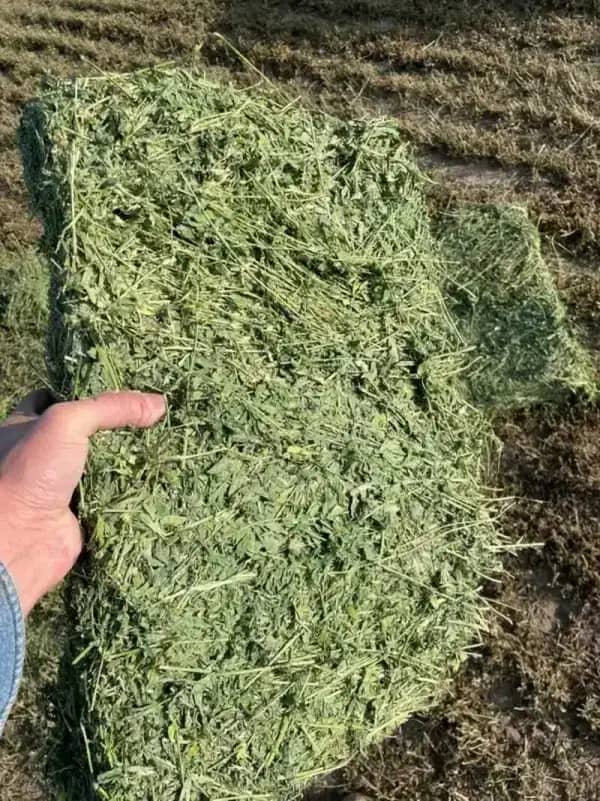
"3-way" means three forages baled together, usually timothy, orchard grass and alfalfa. Each one is there for a reason:
- Timothy brings fine-stemmed fiber and long chewing time.
- Orchard grass adds bulk and a softer, leafier texture that most horses eat readily.
- Alfalfa is a legume, so it carries more protein and calcium than either grass.
How much of each forage ends up in a given bale depends on how the field was planted and cut, and it can change from one load to the next. That is the main thing to understand about any mixed hay: you are buying a blend you cannot adjust.
Which Horses It Suits, and Which It Does Not
A good fit:
- A barn of easy, healthy horses at maintenance or light riding, where you want one hay for everyone instead of three products in the feed room.
Not a good fit:
- Metabolic, insulin resistant or laminitis-prone horses. For these horses your vet usually wants a sugar number to stay under. With three forages in the bale, one flake is not guaranteed to match the next. Feed these horses a single hay with a lab panel. For comparison, our timothy 1st cut and timothy 2nd cut lots both tested at 7.5 percent NSC on their published Equi-Analytical panels (sampled September 30, 2025 and August 4, 2025). Our guide on feeding metabolic horses covers the rest.
- Hard keepers and horses in heavy work that need a known, higher protein and calorie load. A two-forage mix with its own lab panel is easier to plan around.
- Any horse whose vet has set a calcium or protein limit. The alfalfa share is what moves those numbers, and in a 3-way you cannot dial it up or down.
If you are not sure which side your horse is on, start with how it looks and how it is working. A horse holding good weight on plain grass hay does not need the alfalfa. A horse that drops weight on grass alone might, and so might a senior horse with worn teeth.
Why We Switched to a Straight Timothy Alfalfa
We carried a 3-way for a while, and we were not happy with the quality we were getting, so we discontinued it. In its place we now carry a straight timothy alfalfa mix: timothy and alfalfa together in a 3-string bale, with no orchard grass.
Two forages instead of three gives you something a 3-way does not: a lab panel you can plan around. Our Timothy Alfalfa Mix tested at 19.9 percent crude protein as fed and 11.6 percent NSC, with a relative feed value of 177, sampled June 30, 2026 by Equi-Analytical Laboratories. We test the field, not each bale, so treat that panel as a description of the lot.
It suits the same kind of barn a 3-way does: light riders, pleasure horses, growing youngsters and older horses that need some alfalfa softened by the fiber of timothy. It carries more protein than a straight timothy and is easier on the gut than straight alfalfa. Our three-string bales run 85 to 100 pounds.
At 11.6 percent NSC it is not the hay for a horse on a strict sugar limit. Those horses do better on a straight timothy with a lower panel.
Switching to a Mixed Hay
Any change in hay is a change for the gut, and that includes adding alfalfa to a horse that has only eaten grass. Mix the new hay in with the old over a week or two and watch the manure and the appetite. Our guide on transitioning a horse to new hay walks through it.
If you are within reach of Williston, our store is at 21091 NE US Hwy 27, about 22 miles west of Ocala and 25 miles southwest of Gainesville, and the crew loads your truck or trailer for you.
Frequently Asked Questions
What is 3-way hay? 3-way hay is three forages baled together, usually timothy, orchard grass and alfalfa: two grasses for fiber and chewing time, and a legume for protein and calcium.
Is 3-way hay safe for horses with metabolic issues? It is not the hay we would pick for them. A metabolic horse needs a hay with a known sugar number, and a three-forage bale is hard to pin down. Choose a single hay with a lab panel and run the numbers past your vet.
Do you still sell 3-way hay? No. We discontinued our 3-way because we were not happy with the quality, and replaced it with a straight timothy alfalfa mix in a 3-string bale.
What does your timothy alfalfa mix test at? 19.9 percent crude protein as fed, 11.6 percent NSC and a relative feed value of 177, sampled June 30, 2026. Ask for the current panel before you build a diet around it.
Is 3-way hay better than straight timothy? It has more protein than a straight grass because of the alfalfa, and you give up control, because you cannot change the ratio. For a herd of healthy horses that is a fair trade. For a horse on a measured diet, straight timothy with a lab panel is easier to manage.
The Bottom Line
For a barn of healthy horses at maintenance, a mixed hay is a practical way to feed one forage to everyone. For a horse whose diet is measured, buy a single hay with a lab report instead. We no longer carry a 3-way; our timothy alfalfa mix fills that spot, with a lab panel to go with it. Call the Williston store at (352) 528-1255, tell us what your horses do and what they eat now, and we will tell you whether it fits.
From the Williston yard
Questions about the right hay for your horse?
Call Hailey at the Williston store, or browse the catalog and we will get a load on the truck. Hay delivery runs across North Central Florida.