How Many Hay Bales Fit in a Truck or Trailer?
On this page
Space is rarely what stops you, weight is. Find your payload on the driver door sticker, or your trailer GVWR minus its empty weight, then divide by the heaviest your bales might run. Our three-string bales run 85 to 100 pounds, two-string bales average 40 to 50, round rolls average about 500, and our big alfalfa bales are roughly 1,200 pounds full or about 600 cut in half. Plan at the heavy end so you do not overload, strap the load properly, and cover it if rain is anywhere in the forecast.
"Will that fit on my trailer?" is one of the most common questions we get on the phone, and the honest answer is that it usually fits long before it is legal to haul. Hay is heavier than people expect. A load that looks modest sitting on the deck can put a half-ton pickup well over its rated payload, and that is a brake, tire, and suspension problem, not a hay problem.
Here is how to work it out before you drive over.
Start With Weight, Not Space
Hay is dense enough that almost every pickup and light trailer runs out of legal weight before it runs out of room. So the math starts with two numbers, both of which are printed on your own vehicle.
Your truck's payload. Open the driver door and read the sticker on the jamb. It carries a line close to "the combined weight of occupants and cargo should never exceed" a figure in pounds. That figure is everything you put in the truck: you, your passengers, the toolbox, the tack, and the hay. It is not the same as your tow rating and it is usually smaller than people guess.
Your trailer's capacity. The VIN sticker on a trailer lists its GVWR, the maximum the loaded trailer may weigh. Subtract the trailer's own empty weight and what is left is your cargo allowance. If the trailer is a bumper pull, you also need the tongue weight to stay inside what your hitch and truck are rated for, which is why loading a trailer evenly matters as much as loading it lightly.
What Our Bales Actually Weigh
Use these when you do the arithmetic. They are our own figures, not industry averages.
- Three-string small squares: 85 to 100 pounds. Hay is a crop, not a manufactured part, so the weight moves with the cutting and the moisture. Teff and some alfalfa come in at the top of that range.
- Two-string small squares: 40 to 50 pounds on average. Easier to handle one at a time, and a common pick for people feeding one or two horses or loading by hand.
- Round rolls: about 500 pounds each. These are not a pickup item. You need a tractor, a skid steer, or a flatbed and a plan for getting it off at the other end.
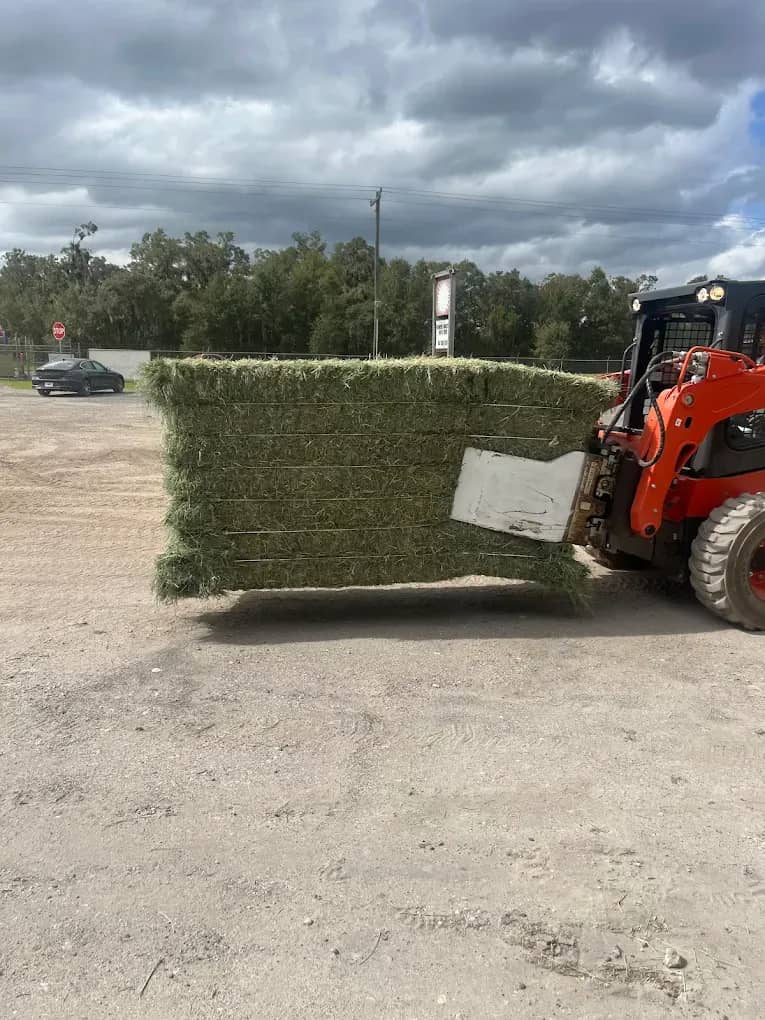
- Big alfalfa bales: roughly 1,200 pounds, or about 600 pounds cut in half. We can halve a big bale when a full one is more than you can move or store.
We run a 5,000 pound certified scale and weigh all of our big bales on it. Customers occasionally ask us to weigh three-string bales too.
Do the Math at the Heavy End
When you are working out how much hay you need for the month, you plan at the light end so you do not run short. When you are working out what your truck can haul, you do the opposite and plan at the heavy end, because the consequence of being wrong is an overloaded vehicle.
So use 100 pounds per three-string bale and 50 pounds per two-string bale for load planning.
A few worked examples, using payload figures you should replace with your own sticker:
- A half-ton pickup with 1,500 pounds of payload, carrying one 200 pound driver, has about 1,300 pounds left. That is 13 three-string bales, or 26 two-string bales, and no more.
- A three-quarter ton with 3,000 pounds of payload and one passenger has roughly 2,600 pounds left, or about 26 three-string bales.
- A 16 foot utility trailer with a 7,000 pound GVWR that weighs 2,000 pounds empty can carry about 5,000 pounds, which is around 50 three-string bales, assuming your truck and hitch are rated for the loaded trailer.
Bale dimensions vary with the hay and the cutting, so if you are working to a tight deck size, measure your deck and confirm the bale size when you order rather than guessing from a photo.
Stacking and Strapping
Weight decides how much. Stacking decides whether it arrives.
Lay the bottom course flat and tight against the headboard so nothing can shift forward under braking. Cross the courses above it where you can, the way a brick wall laps its joints, so the stack ties itself together. Keep the load low and centered rather than tall and narrow, and on a trailer keep a little more weight ahead of the axles than behind them so the tongue stays loaded and the trailer does not sway.
Then strap it. Ratchet straps over the top of the stack, front to back and across, hooked to real anchor points and not to the bed rail lip. Baling twine is not a tie-down. A load of hay that comes off on the interstate is your liability, and Florida requires loads to be secured.
If there is rain anywhere in the forecast, tarp it. Hay that arrives wet does not dry out into good hay again, it heats and molds from the inside, and you have bought a problem instead of a feed. Our guide on storing hay in Florida heat and humidity covers what happens to a damp stack once it is home.
When to Skip the Pickup Entirely
If you are buying by the ton, filling a barn ahead of winter, or feeding a pasture herd, a pickup is the expensive way to do it. Delivery exists for exactly this, and so does buying by the load or by the container, which is how larger barns keep their cost per pound down without making six trips.
Round rolls are the clearest case. At about 500 pounds apiece, and needing equipment on both ends, they usually make more sense delivered than self-hauled unless you already run a tractor.
Frequently Asked Questions
How many hay bales fit in a standard pickup bed? By weight, most half-ton pickups top out around 13 three-string bales once the driver is accounted for. Read the payload figure on your own driver door sticker and divide it by 100 pounds per bale, because payload varies a lot between trucks that look identical.
How much does a hay bale weigh? Our three-string small squares run 85 to 100 pounds and our two-string bales average 40 to 50 pounds. Round rolls average about 500 pounds and our big alfalfa bales are roughly 1,200 pounds, or about 600 pounds as halves.
Can I haul a round bale in a pickup truck? Not safely in most cases. A roll averages about 500 pounds and is awkward to secure in a bed, and you still need a way to unload it at home. A flatbed or trailer plus a tractor or skid steer is the normal setup, and delivery is usually the easier answer.
Do I need to cover hay for the drive home? Cover it any time rain is possible. Wet hay does not recover, it molds, and a tarp is cheaper than a lost load. A tarp also stops loose leaf from blowing off the top course on the highway.
Can someone else pick up my order? Let us know when you order who is collecting and what they are driving, so the yard is expecting them.
The Bottom Line
Count weight, not bales. Find the payload number on your own truck or trailer, plan at the heavy end of our weight ranges, stack low and tight, and strap it properly. If the number comes out smaller than the load you need, that is what delivery and bulk ordering are for. Call the Williston store if you want help sizing a load before you drive over.
From the Williston yard
Questions about the right hay for your horse?
Call Hailey at the Williston store, or browse the catalog and we will get a load on the truck. Hay delivery runs across North Central Florida.